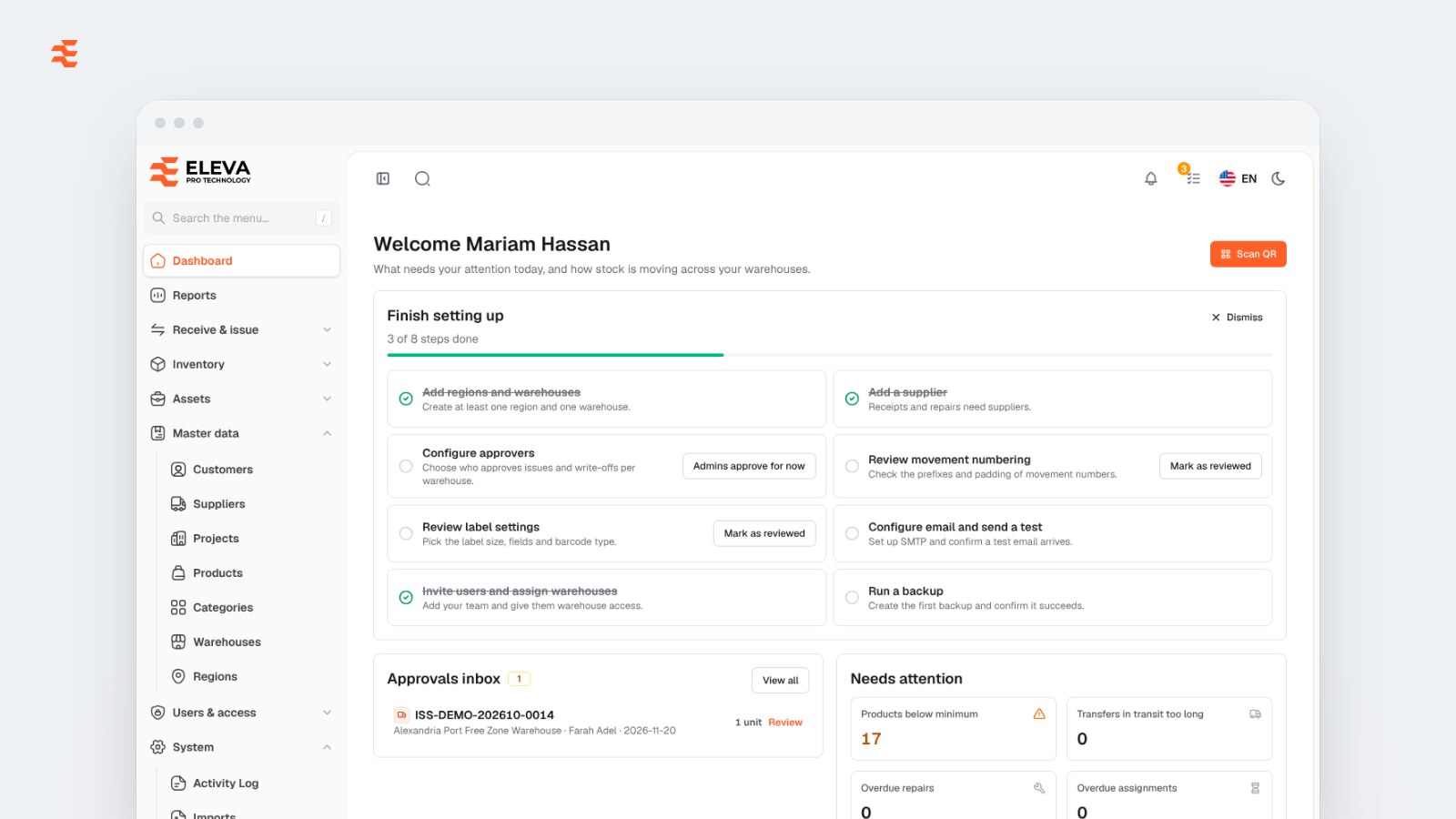
Your warehouse needs a system instead of paper and phone calls when "where is that unit right now?" can only be answered from someone's memory or by phoning them, when every stock count ends in surprises, when approvals live in chat messages, when transfers are "on the road" with no proof of arrival, and when reports are rebuilt by hand and arrive too late. Below are five practical signs you can test this week without buying anything. If two or more show up regularly, the problem is no longer your team's effort; it is the tool they work with.
Key takeaways
- The clearest sign: nobody can say where a specific unit is without calling someone else.
- A stock count that ends with discrepancies nobody can explain means movements are not recorded when they happen.
- An approval given in a chat or on paper leaves no trail you can review later.
- Test each sign with a simple question and measure the result before deciding; not every small warehouse needs a system today.
Why do companies notice the need for a system so late?
Because paper, phone calls and WhatsApp groups work at first. With one warehouse, familiar items and a storekeeper who knows every shelf personally, things feel under control. The catch is that this way of working relies on people rather than records, so the gap grows quietly with every new warehouse, every new hire and every customer who asks for proof.
The gap between the books and reality is not rare, even in large companies. In a study published in Management Science in 2008, Nicole DeHoratius and Ananth Raman examined nearly 370,000 inventory records across 37 stores of a single US retailer and found 65% of them inaccurate: the recorded quantity did not match what was physically there. The figure describes one company and should not be generalised as is, but it shows that having a record is not the same as having a correct record. The same study found that inventory auditing practices reduce these errors.
Sign 1: "Where is it?" takes a phone call
If you asked today about a specific device, spare part or tool, how many minutes would it take to learn where it is, what state it is in and who received it? In paper-run warehouses the usual answer is "let me ask so-and-so and get back to you". That is fine once. It becomes expensive when it happens every day, and when so-and-so is on leave or leaves the company.
Time is not the only cost. In a 2001 California Management Review article, Raman, DeHoratius and Ton reported that at one retailer, misplaced items stopped one in six customers who asked for help from finding a product that was actually in the store. Stock that exists but cannot be found behaves, in practice, as if it were missing.
Test it: pick five units at random from your records and ask someone other than the storekeeper to locate each one and state its condition within two minutes, without calling anyone. If they fail on more than one, this sign is present.
Sign 2: Stock counts are exhausting and full of surprises
When the count is a yearly event that stops work for days and ends with discrepancies written off in a single adjustment with no explanation, it means daily movements are not recorded when they happen. A unit went to a customer and no issue note was written, or it moved to another warehouse and was recorded a week later, or it was swapped during a repair without the store knowing.
The difference between a system-run warehouse and a paper-run one is not that the first never has discrepancies. It is that a discrepancy is found early and can be traced to a specific movement. If yours recur, review the common reasons physical stock does not match the books before blaming anyone.
Test it: how many days did your last count take, and how many of its discrepancies can you explain precisely today? If the answer for most of them is "we don't know", this sign is present.
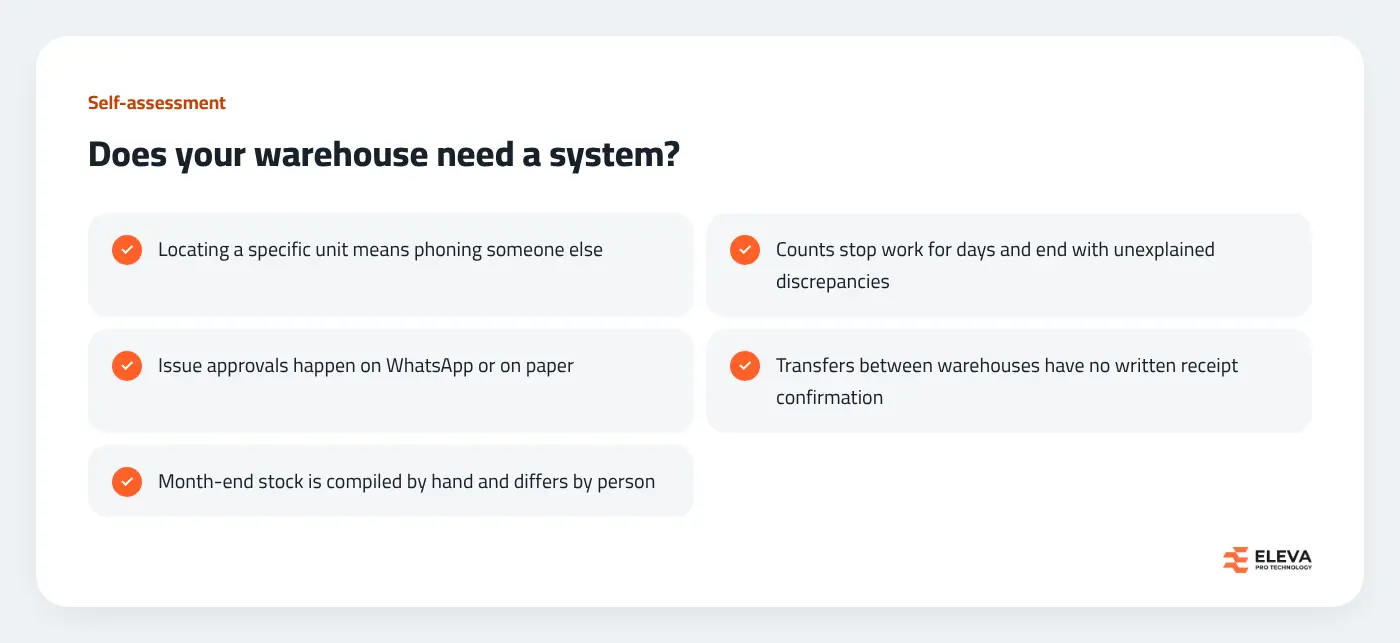
Sign 3: Approvals happen on WhatsApp and on paper
In many companies a stock issue is requested by voice note, the manager replies "OK", and the unit leaves. Six months later, when an auditor or a director asks who approved that issue and at what value, someone starts scrolling through old chats. The approval happened, but it was never recorded in one place tied to the movement itself.
The risk grows when the same person requests, approves, receives and records. Separating those roles is a basic control principle, and paper does not enforce it. A system does, by stopping users from approving a request they created and by adding approval levels as the value rises.
Test it: take three issue notes from last month and try to establish, within five minutes, who requested each one, who approved it and when. If you have to reach for your phone, this sign is present.
Sign 4: Stock "on the road" with no proof of arrival
Once you run more than one warehouse or site, a new problem appears: goods between two places. The shipment left the main warehouse, but did it arrive complete? Did a damaged unit arrive? Who is responsible for it while it is on the truck? If the answer is a call from the driver or a WhatsApp photo, there is no evidence to fall back on when there is a dispute.
Fixing this link has its own tools, from the transfer document to unit-by-unit receipt confirmation, and we cover them in a dedicated article on organising inter-warehouse transfers and knowing what is in transit.
Test it: how many transfers left last month and still have no written confirmation of receipt? If you cannot answer that question, this sign is present.
Sign 5: Reports are built by hand and arrive too late
Management asks for stock at the end of last month, the value held in one warehouse, or the items that have fallen below their minimum. Someone spends a day or two gathering papers and files, and the report lands after the decision has been made. Worse, an item runs out before anyone notices, because the alert depends on someone remembering to open the file.
A hand-built report is not only slow; it is hard to verify. Every version differs slightly from the last, and nobody knows which one is right.
Test it: ask for one warehouse's stock as it stood on the last day of last month. If it takes more than an hour, or two people produce two different numbers, this sign is present.
Self-assessment: paper and calls versus a warehouse system
Use this table to summarise what you found. The last column shows what changes in practice when you move to a system, whichever system you choose.
| Sign | How to test it this week | What changes with a system |
|---|---|---|
| "Where is it?" | Locate 5 random units in two minutes without calling anyone | Every unit has a code, status and location, opened by scanning |
| Surprise counts | Explain every discrepancy from the last count | Scan-based cycle counts compare found against expected immediately |
| Scattered approvals | Trace 3 issue notes: who requested, who approved, when | Stages and approvals recorded inside the movement itself |
| Stock on the road | Count transfers with no written receipt | Receipt confirmed per unit, with damaged and missing recorded |
| Manual reports | Ask for last month-end stock | A ready report from the same records, with export |
When you do not need a system yet
Not every warehouse needs a system today. If you have one site, a limited number of items managed by quantity rather than by individual unit, one person who handles receipts and issues and knows everything, and the tests above pass without trouble, a well-organised spreadsheet may be enough. We discuss this fairly in when Excel is enough for warehouse management and when it starts costing more than it saves.
A simple rule: if one sign shows up occasionally, fix the procedure first. If two or more show up regularly, or you plan to open a second warehouse or grow the team, it is better to move before the gap widens rather than after.
What to do once you are sure
- Write down your test results as numbers: how many minutes, how many discrepancies, how many unconfirmed transfers. That is your baseline for measuring improvement.
- Map the unit's journey through your company from receipt to issue, as explained in our guide to choosing a warehouse management system, and use its 12 questions in every demo.
- Start with one warehouse and the most painful sign, then expand. The detailed plan is in how to move from paper to a warehouse system in 30 days.
How Eleva's system handles this
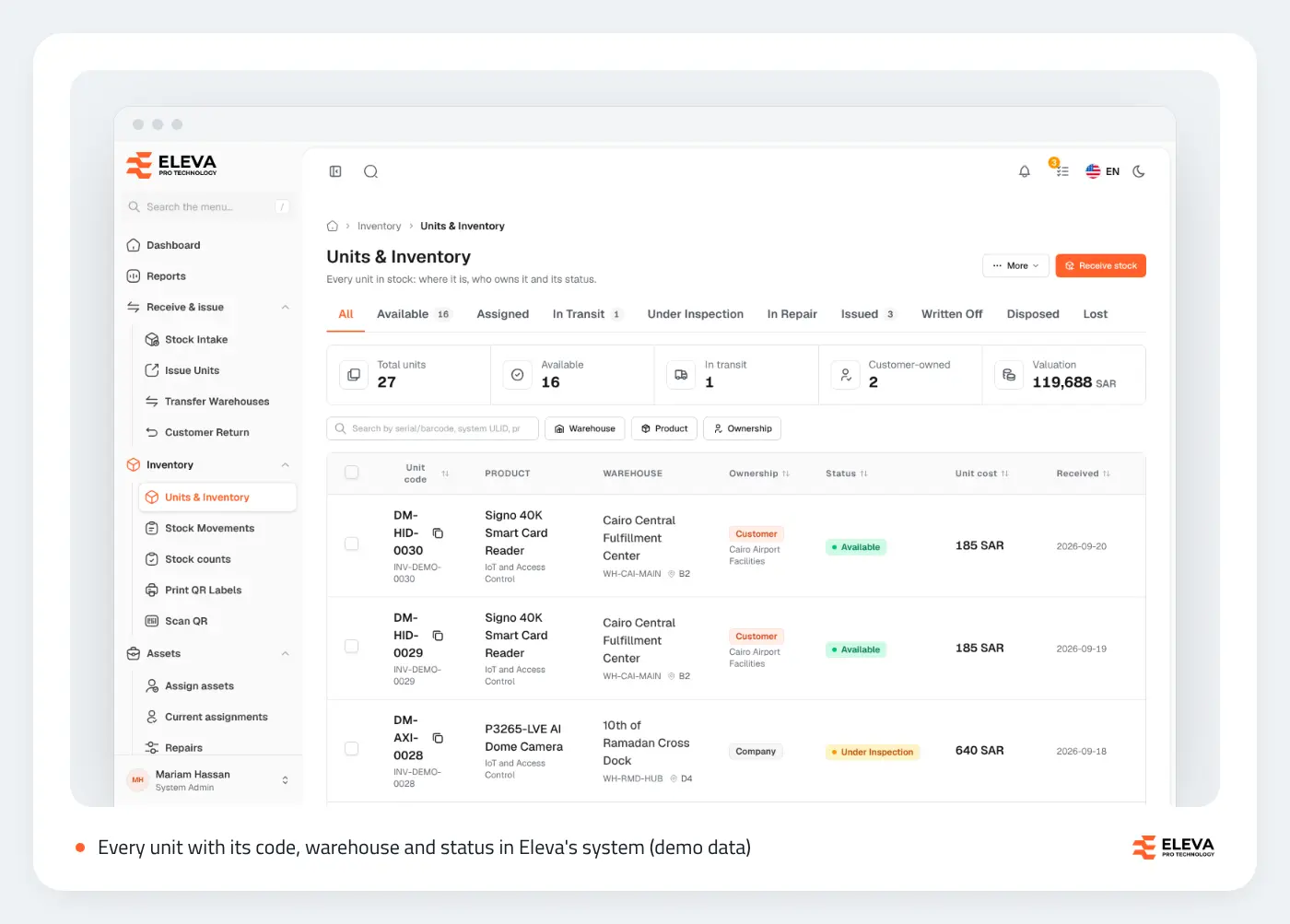
At Eleva we build the Warehouse Tracking & Management System, and it addresses the five signs as follows. Every unit gets a permanent tracking code and a QR or barcode label, and its details and movement history open when it is scanned on the Scan QR screen with a phone camera or a USB scanner. Every movement, from receipt to issue and transfer, has a number, a status, and who performed it and when in the stock movements list. Issues and write-offs pass through value-based approval levels, and one person cannot approve more than one level of the same movement.
A transfer between warehouses is confirmed with a six-digit delivery code, and the receiver marks each unit as received, damaged or missing. The dashboard collects what needs your attention: pending approvals, products below minimum and transfers in transit too long. Stock counts are done by scanning and sort units into matched, missing and unexpected, and the reports hub can show stock as it stood on any past date.
FAQ
Is Excel enough instead of a warehouse system?
It can be for one small warehouse with a few items managed by quantity and one person in charge. Once you run several warehouses, need to track each unit by its code, or need documented approvals, a spreadsheet struggles to enforce rules or keep a record of who did what.
What is the first thing I should measure?
The time it takes to locate a specific unit and state its condition without calling anyone, and the share of units that can be located successfully. It is a quick test and it exposes most of the other problems.
Do I need special scanning hardware to move to a system?
Not necessarily. Many modern systems, ours included, read QR codes and barcodes with a phone or tablet camera and also accept USB handheld scanners.
Conclusion
Paper and phone calls are not wrong in themselves, but they stop working as a warehouse grows or multiplies. Test the five signs this week with real numbers, and if two or more show up regularly, start by mapping the unit's journey and choosing the right system. If you want to see what these signs look like once they are fixed, on data close to yours, contact us to book a demo.
Try the Warehouse Tracking & Management System yourself: the live demo with sample data, and the step-by-step user manual. The system is sold as a one-time licence or a fixed annual fee plus annual maintenance, installed on your company's server with no fee per warehouse or user. Request a demo from the product page.