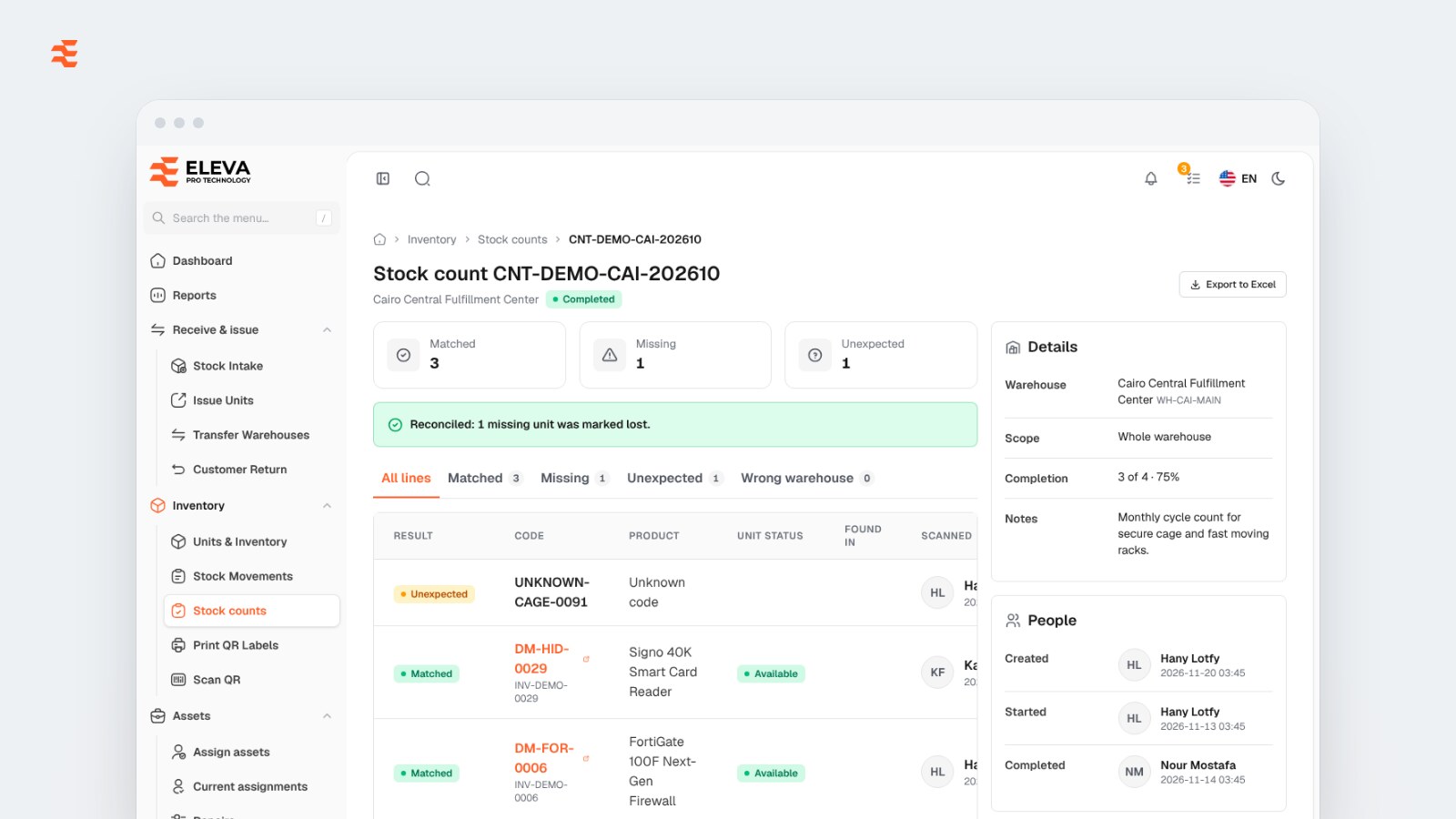
Cycle counting means counting a small part of your stock every day or every week on a fixed schedule, so every item is counted at least once during the year and the highest-value or fastest-moving items (class A) are counted more often than the rest. You no longer need to close the warehouse for days for an annual wall-to-wall count, and you find discrepancies days after they happen rather than months. This guide explains how to classify your items with ABC analysis, how to calculate how much to count each day, how to count without stopping receipts and issues, and what to do with the discrepancies you find.
Key takeaways
- Cycle counting spreads the counting load across the year: a little every day instead of everything at once.
- Classify items with ABC analysis by annual consumption value, and put critical items in class A whatever their value.
- Calculate the daily load: items in each class × counts per year ÷ working days.
- Never adjust a discrepancy before a recount and a check of open movements, then look for the cause, not just the number.
How is cycle counting different from an annual full count?
In an annual wall-to-wall count the warehouse stops, the team counts everything at once, and discrepancies are adjusted in one go. In cycle counting, a defined part of the stock is counted in defined locations on defined days, on a recurring schedule, until every item has been covered within a set period. The table sums up the difference:
| Aspect | Annual full count | Cycle counting |
|---|---|---|
| Work stoppage | A day or more, depending on warehouse size | None; a small part is counted each time |
| When a discrepancy is found | Months after it happened | Days or weeks after |
| Tracing the cause | Hard, movements have piled up | Easier, the period is short and movements are few |
| Count quality | A tired team counting everything quickly | A small team counting carefully |
| Focus | All items equally | Important items counted more often |
Will auditors accept cycle counts instead of an annual count? That depends on the strength of your controls and on the auditor. As one example, the US auditing standard PCAOB AS 2510 says that when well-kept perpetual inventory records are checked periodically against physical counts, the auditor can usually observe counts during or after the period, and that some companies use methods reliable enough to make an annual count of every item unnecessary, provided the auditor is satisfied they produce substantially the same results. It is a US standard, so agree with your own auditor on what they accept in your country before dropping the annual count.
The benefit is not only regulatory. In DeHoratius and Raman's 2008 Management Science study of nearly 370,000 inventory records at a single retailer, 65% of records were inaccurate, and the authors found that inventory auditing practices reduce record inaccuracy. In other words, regular counting is not just an accounting ritual; it is how you correct the data every decision depends on.
Step 1: Classify your items with ABC analysis
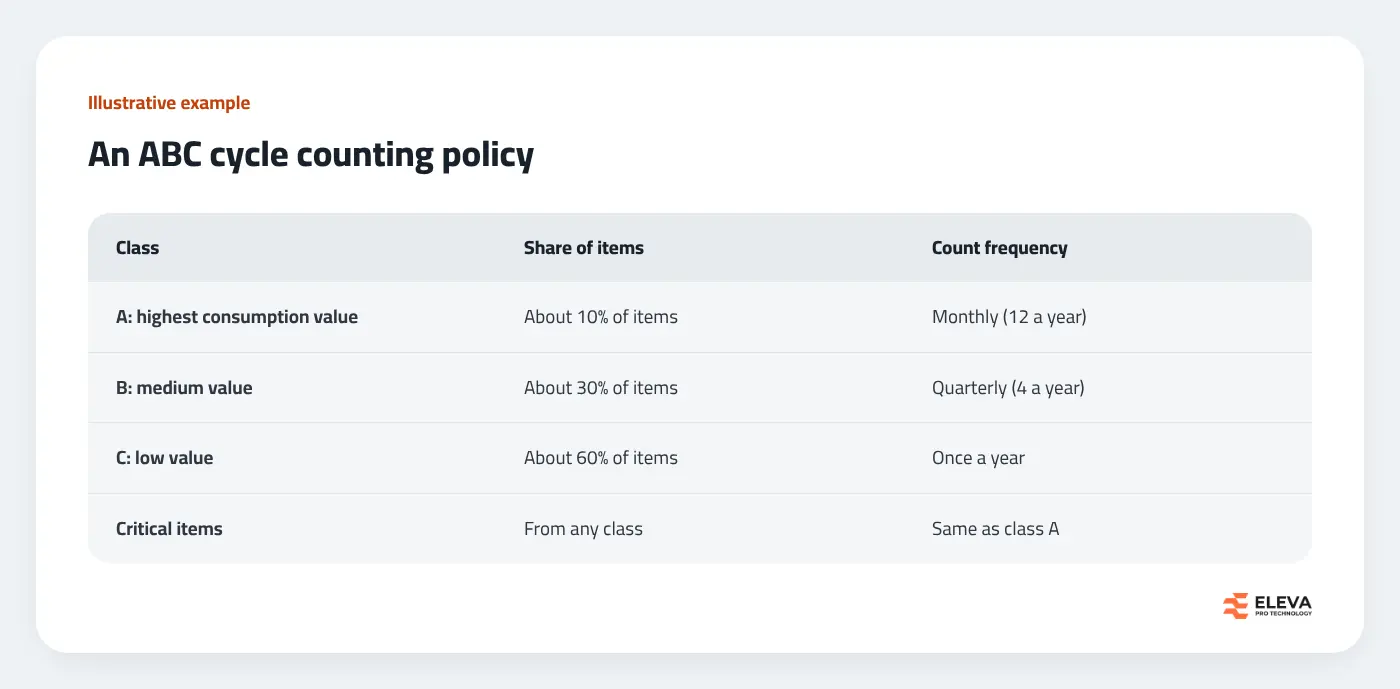
ABC analysis rests on a familiar observation: a small number of items usually accounts for most of the stock's value or movement. So there is no point counting a screw as often as an expensive device. To classify:
- Calculate each item's annual consumption value: quantity issued per year × unit cost.
- Sort items in descending order of that value and work out the cumulative share of the total.
- Draw the lines: the items that together make up most of the value are A, the next group is B, and the rest are C. There are no mandatory percentages; choose cut-offs that suit your warehouse and your team's capacity.
- Add exceptions: a cheap but critical item, such as a spare part that stops a production line when missing, or an item prone to theft, is treated as A whatever its value.
- Reclassify periodically, for example every quarter, because new and seasonal items change the ranking.
Step 2: Set frequencies and calculate the daily load
After classifying, decide how many times a year each class is counted. A common starting policy: A monthly, B quarterly, C once a year. Then work out how many items must be counted per day, because that number tells you whether the plan is actually workable.
Illustrative example: a warehouse with 2,000 items, 200 in class A, 600 in B and 1,200 in C, working 250 days a year:
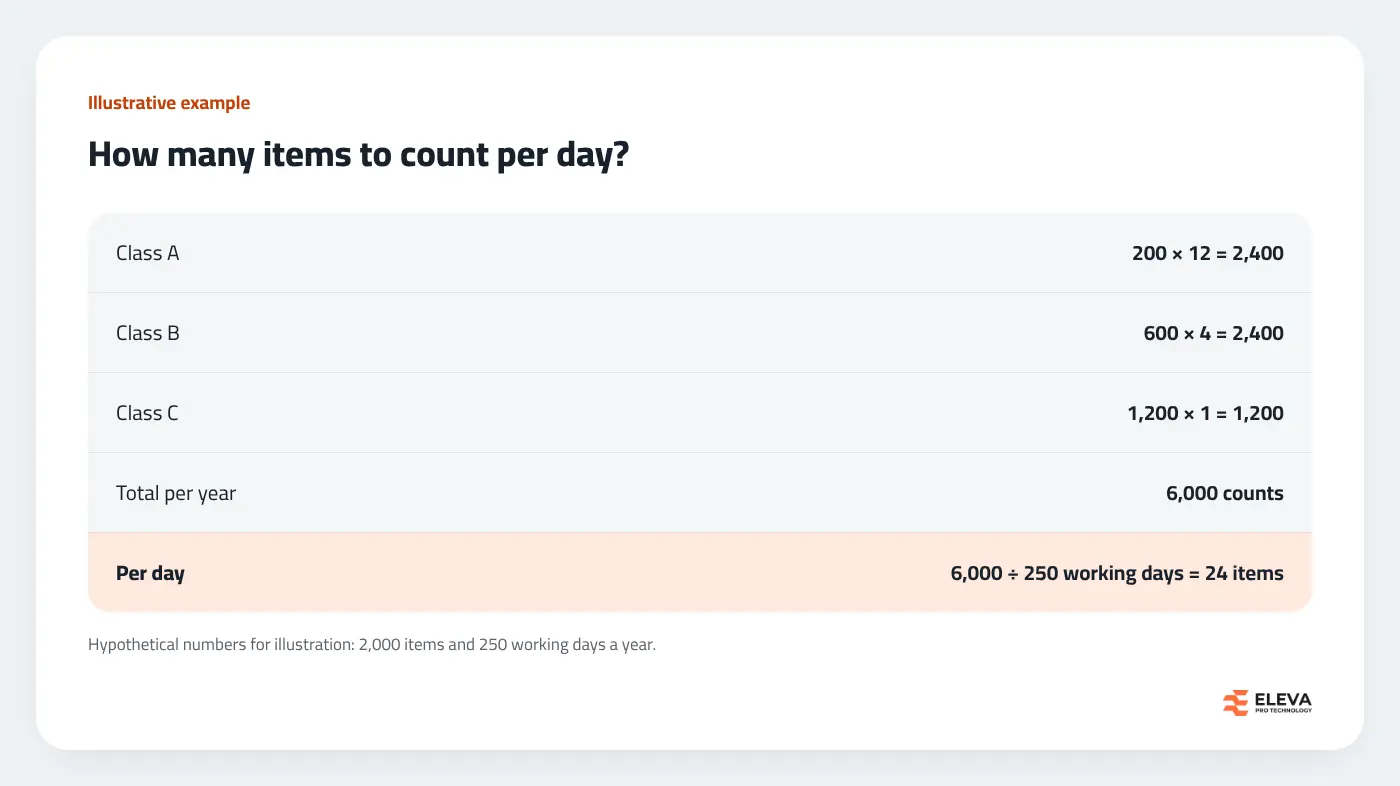
Twenty-four items a day is a job one person can finish in part of a shift, especially when counting by scanning rather than on paper. If the number comes out larger than your team can handle, reduce the frequency for class C or split the warehouse into zones counted in rotation, rather than abandoning the plan.
Step 3: Count without stopping work
The real challenge in cycle counting is that the warehouse keeps working during the count: receipts, issues and transfers continue. These rules stop movements from spoiling the result:
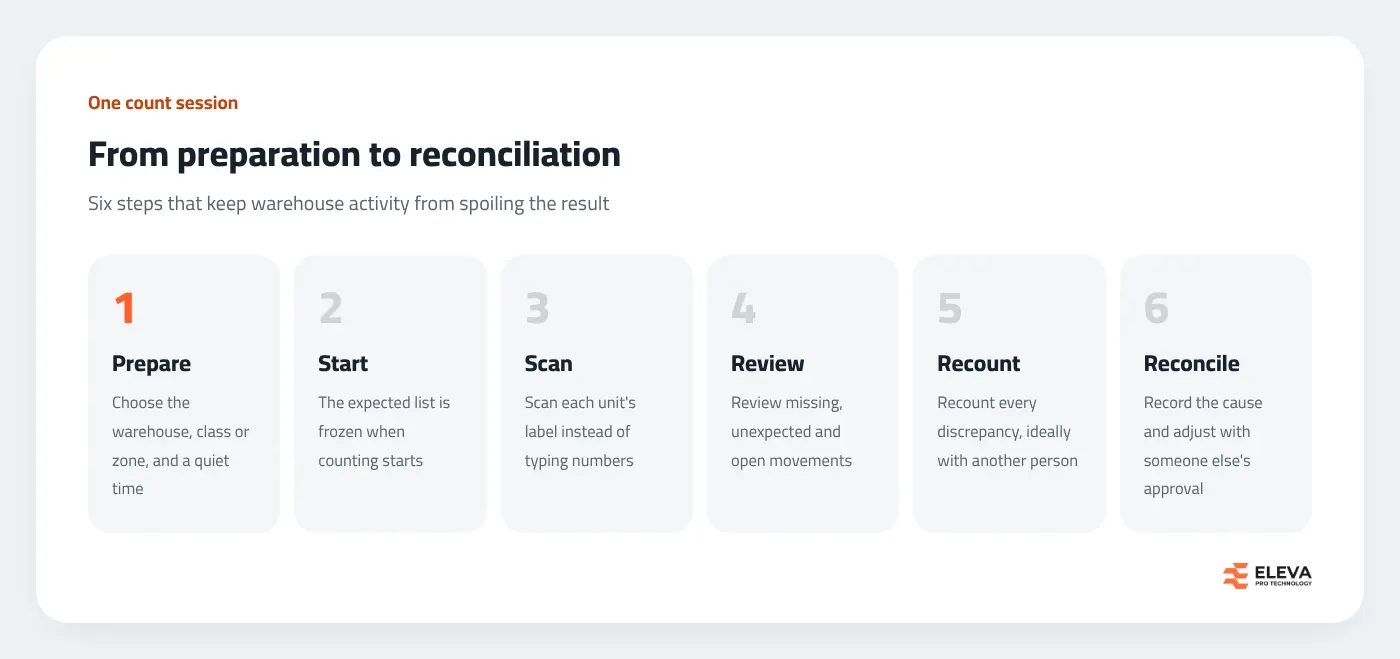
- Freeze the expected list when you start: what should be there is calculated when counting begins, not the day before.
- Pick a quiet time: the start of a shift or after the last issue run, and count one zone or rack at a time.
- Handle open movements: stock in transit, or reserved for an issue that has not completed, is checked before it is treated as a discrepancy.
- Scan, don't type: reading a label with a camera or scanner is more accurate than copying numbers by hand. Choosing the label type is a topic of its own, covered in QR code or barcode: which labelling suits your warehouse.
- Separate the counter from the custodian: ideally the storekeeper does not count their own stock unchecked; assign someone else or have a second person review the count.
- Count blind where possible: a counter who cannot see the expected quantity is not tempted to "find" the number they expect.
Step 4: Work through discrepancies before adjusting them
A discrepancy found in a count is not necessarily a loss. Before any adjustment, follow this order:
- Recount the item or unit in question, ideally with a different person.
- Check open movements: is there a transfer not yet received, an issue not marked complete, a unit out for repair?
- Look in other warehouses: a unit "missing" here may be recorded in, or physically sitting in, another warehouse.
- Record the cause of each discrepancy: receiving error, unrecorded issue, misplacement, damage or genuine loss.
- Adjust with approval, and do not let the person who counted approve the adjustment.
A recurring cause matters more than the number. If most discrepancies are "unrecorded issue", the problem is in the issuing procedure, not in the count. For the common causes in depth, read why physical stock does not match the books.
How do you measure whether cycle counting works?
The core metric is inventory record accuracy: records where the count matched the system ÷ records counted. Illustrative example: you counted 500 items this month and 470 matched the record, so accuracy is 470 ÷ 500 = 94%.
- Set a tolerance: for items tracked by unit and serial number, the tolerance is zero; a unit is either there or it is not. For items managed by quantity, a small tolerance agreed in advance can be acceptable.
- Measure each class separately: 98% accuracy in class C does not make up for 85% in class A.
- Tie frequency to results: if accuracy drops in a class or a zone, count it more often until it settles, then return it to the normal schedule.
- Report it to management monthly as part of your weekly and monthly warehouse reports, with the top three causes of discrepancies.
Common cycle counting mistakes
- Starting with an ambitious plan the team cannot sustain, then stopping after a month.
- Counting only what is easy and postponing high racks and congested areas.
- Adjusting discrepancies straight away without a recount or a check of open movements.
- Not recording who counted and when, which makes the result hard to review later.
- Fixing the number and ignoring the cause, so the same discrepancies return every month.
How Eleva's system handles this
In Eleva's Warehouse Tracking & Management System, you create a new stock count for a whole warehouse, a single product category or a single product, which suits counting class A or one zone in a short session. The count is saved as a draft, and the list of expected units is fixed only when counting starts; a draft does not reserve units or block movements.
During the count the team scans QR or barcode labels, and the stock count details screen compares each reading with the expected list, sorting lines into matched, missing, unexpected and wrong warehouse, with who scanned each unit and when, plus export to Excel. If the connection drops, count readings are kept on the device and sent when it returns, without duplicates. The stock counts list shows each count's status and how many expected units have been found. The ABC classification itself is something you prepare from the stock reports or in a spreadsheet, then create counts to match.
FAQ
How often should I cycle count?
There is no single right number. A common starting point is class A monthly, B quarterly and C once a year, then adjust based on the accuracy you measure and your team's capacity.
Does cycle counting replace the annual stock count?
It can, if your records are well kept, counts are documented and your auditor is satisfied they are reliable. Agree with them in advance; some companies keep a lighter annual count in the first year until results are proven.
Who should do the counting?
Ideally someone other than the person directly responsible for the stock, or a second person who reviews the count, with a third person who has the authority approving adjustments.
Conclusion
Cycle counting turns the stock count from an exhausting annual event into a small daily habit: classify items with ABC analysis, calculate the daily load, freeze the expected list when you start, and never adjust a discrepancy before recounting and finding the cause. To see where counting fits in warehouse management as a whole, read our guide to choosing a warehouse management system. If you want to see scan-based counting on data close to yours, contact us.
Try the Warehouse Tracking & Management System yourself: the live demo with sample data, and the step-by-step user manual. The system is sold as a one-time licence or a fixed annual fee plus annual maintenance, installed on your company's server with no fee per warehouse or user. Request a demo from the product page.