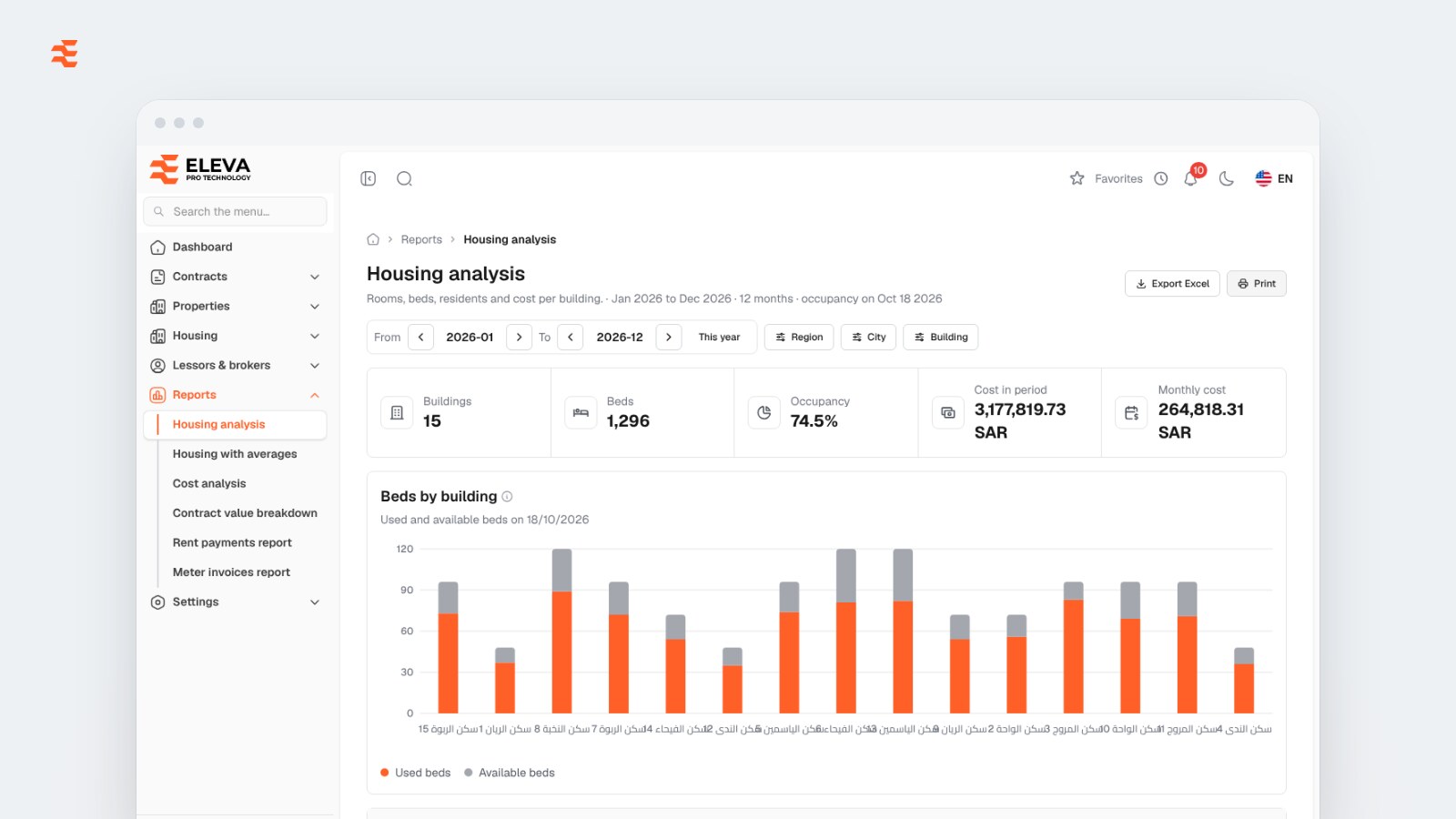
Cost per bed is the monthly cost of a housing building divided by its beds; cost per used bed divides the same cost by the beds actually occupied. The gap between the two is what your empty beds cost you. To get both right, spread each lease's value over the days of the period rather than booking rent when it is paid, and count beds and residents on a fixed date. Total rent tells you what you pay; these two numbers tell you whether that money houses people. This article shows how to calculate them, with an illustrative example, and where housing budgets usually leak.
Key takeaways
- Spread lease value by days: contract value × days of the contract inside the period ÷ contract days.
- Cost per bed measures the price of capacity; cost per used bed measures the real cost of housing one worker.
- In the illustrative example, a building at 80% occupancy costs 25% more per used bed than per bed.
- Empty beds hide in gender splits, units with no lease, and check-outs that were never recorded.
- Compare buildings on cost per used bed before leasing more space or renewing a lease.
Why is total rent the wrong number to manage?
Most companies know what they pay for housing in total: the sum of rent cheques or transfers in the year. That number is useful to finance, but it answers none of the questions a housing manager faces. Which building is expensive for what it gives us? Are we paying for beds nobody sleeps in? Is it cheaper to fill the free beds in one building than to lease another?
Total rent also moves with payment dates, not with use. A building paid annually in advance looks very expensive in one month and free for eleven. A building paid quarterly looks different again. To compare buildings, you need the cost of each building spread evenly over time, divided by what it holds.
Which costs belong in the calculation?
- Lease value: the annual rent over the contract's duration. This is the core of the cost and the part every report should spread by days.
- Broker commission and insurance: one-off amounts tied to a lease. Decide whether your cost model includes them, and apply the same rule to every building.
- Utilities: electricity and water invoices by meter. They vary by month and occupancy, so track them separately and add them when you need the full cost of a building.
Keep the definition fixed and written down. A cost per bed that includes utilities in one building and not in another is worse than no figure at all.
How do you spread a lease over a period?
Use days, not payment dates. For any reporting period, the cost of a lease is:
contract value × days of the contract inside the period ÷ contract days
Illustrative example: a lease runs from 1 July 2025 to 30 June 2026 (365 days) with a value of SAR 288,000. For the reporting period January to December 2026, only 181 of its days fall inside the period (1 January to 30 June). Its cost in the period is 288,000 × 181 ÷ 365 = SAR 142,816.44, whatever the payment cycle. If the lease is renewed from 1 July 2026, the new contract contributes its own days to the second half of the year.
This method also gives finance the part of each lease that belongs to each month, which is what an accrual view of rent needs.
A worked example: cost per bed and per used bed
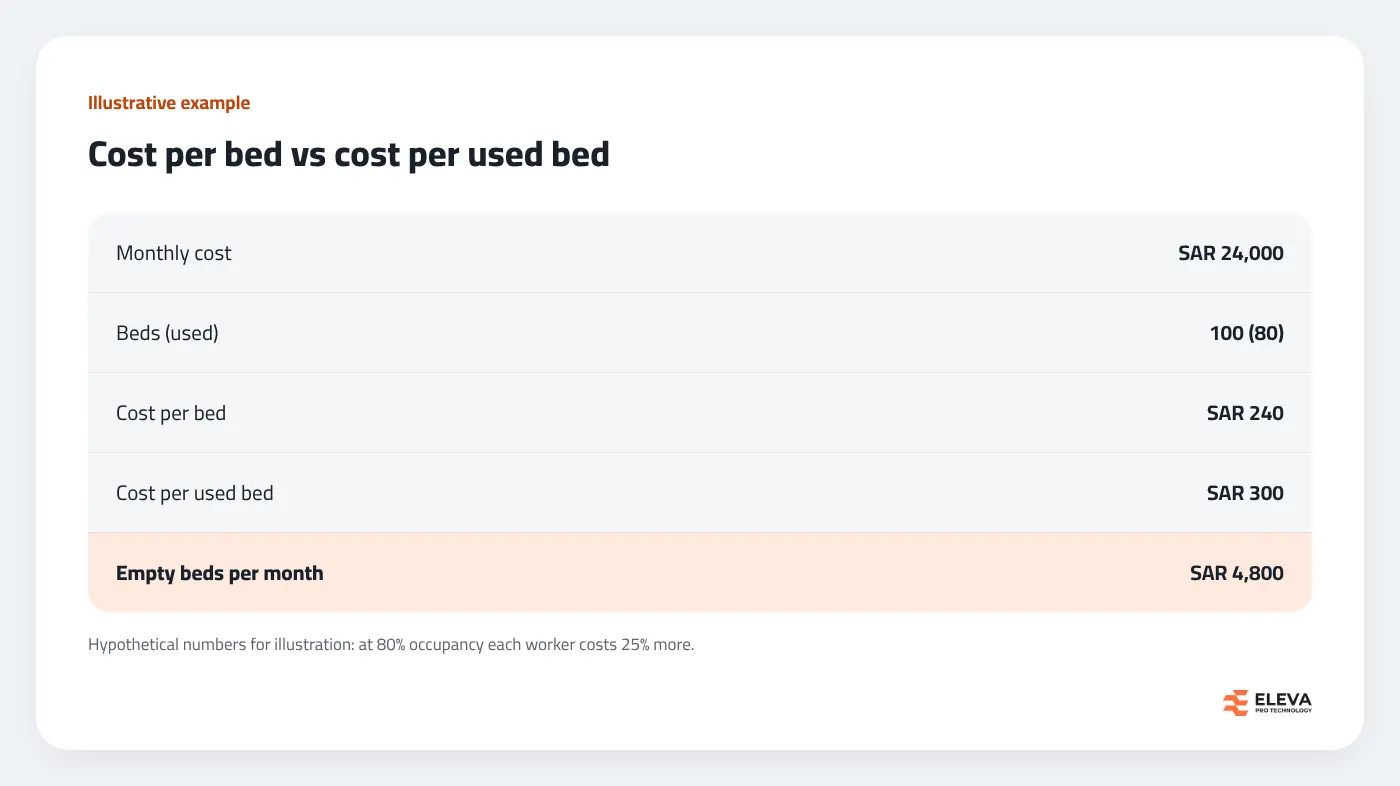
Illustrative example: a building has 100 beds and a lease costing SAR 288,000 for a full year, which is SAR 24,000 a month. On the count date, 80 beds are occupied.
- Cost per bed: 24,000 ÷ 100 = SAR 240 a month.
- Cost per used bed: 24,000 ÷ 80 = SAR 300 a month.
- Cost of the empty beds: 20 beds × SAR 240 = SAR 4,800 a month, or SAR 57,600 a year.
The building's occupancy is 80%, and the real cost of housing each worker is 25% higher than its price per bed suggests. A second building with a higher rent but full occupancy can easily be the cheaper one per worker.
Which metrics should you compare?
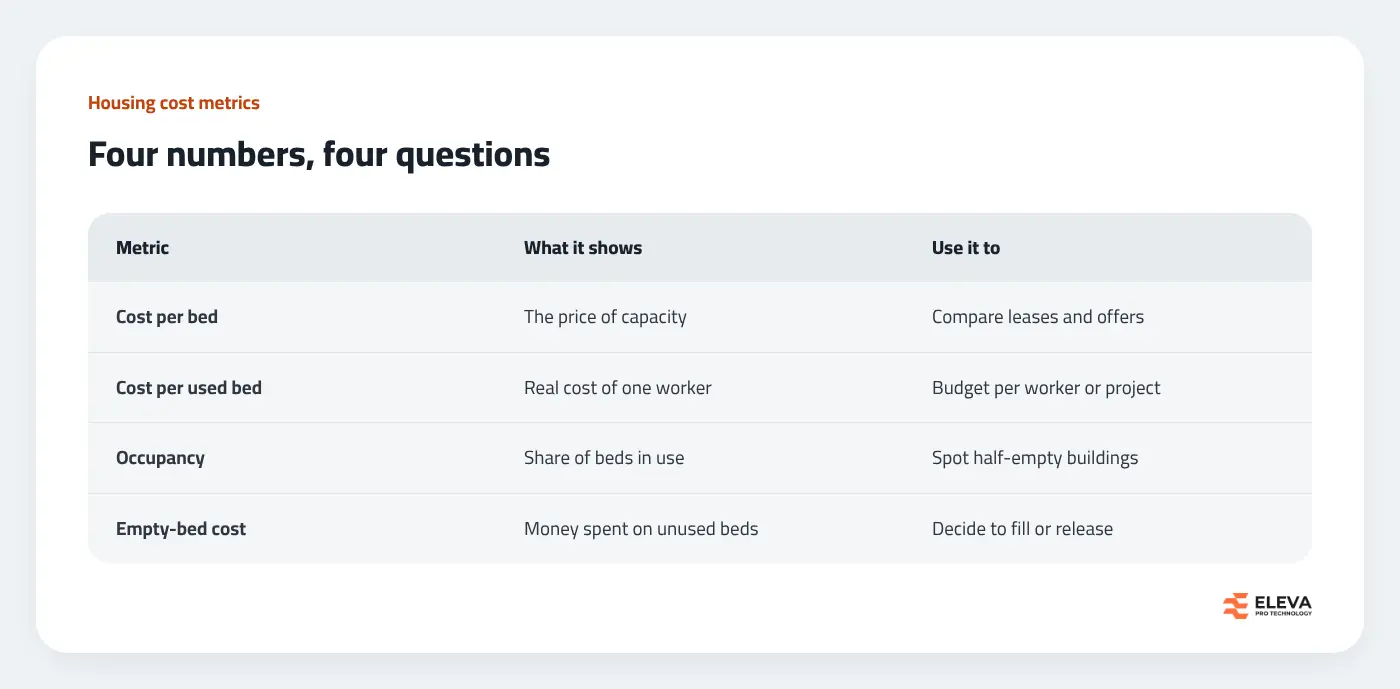
Look at them together. Cost per bed alone favours large, cheap buildings even when they are half empty; occupancy alone ignores what the space costs.
Where do empty beds come from?
- Gender splits: free beds in units for men do not help when the next arrivals are women, and the reverse. Look at free beds by gender, not in total.
- Units with no active lease: a unit whose lease has ended, or that was never covered by the renewal, cannot be used even though it is still counted as space.
- Check-outs not recorded: a leaver's bed stays "occupied" on paper. This hides waste rather than creating it, and makes occupancy look better than it is. Accurate check-in and check-out is the base of every cost figure.
- Scattered residents: ten rooms each one bed short of full, across three buildings, add up to a whole flat you are paying for.
- Leases sized for a peak: a building leased for a project's peak headcount stays expensive after the project winds down.
How can you lower the cost per used bed?
- Fill before you lease. Before signing a new lease, check free beds by gender in the same city and region.
- Consolidate. Move workers from a half-empty building into free beds elsewhere, then release or renegotiate the emptier lease at renewal.
- Prepare renewals early. A reminder well before a lease ends (60 days is a common default) gives time to compare its cost per used bed with alternatives. The lease side is covered in tracking lease contracts and rent instalments.
- Review the split by floor. If one gender's units are always full and the other's empty, adjusting which floors serve whom can free capacity without leasing.
- Report monthly. A monthly table of cost per used bed by building, reviewed with the housing and project teams, turns the figure into decisions.
How Eleva's system calculates it
The Staff Housing Management System from Eleva spreads each contract's value over its days (contract value × days of the contract inside the period ÷ contract days), and counts rooms, beds and residents on the last day of the period, or today if the period has not ended.
The Cost analysis report shows, for each building, its contracts, rooms, beds, used beds and available beds, the monthly cost and the cost per contract, per room, per bed, per used bed and per available bed, with a switch between monthly amounts and the whole period. The Housing analysis report adds residents by gender, empty rooms and available beds per building, and Housing with averages groups the same figures by city and region with subtotals. Every report filters by period, region, city and building, exports to Excel and prints.
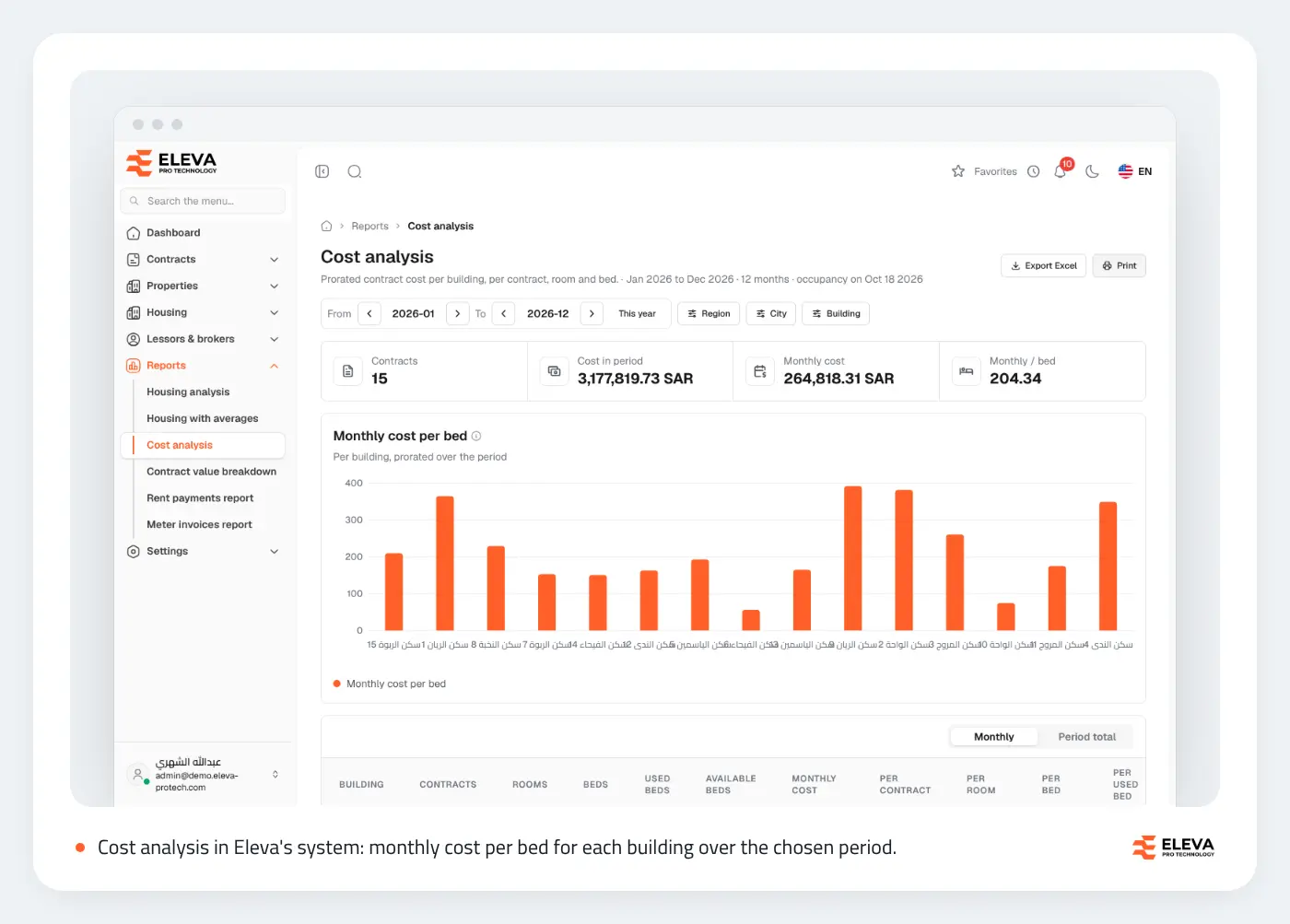
One point to know: the cost reports are built on contract value. Electricity and water appear in their own Meter invoices report, by month and meter type, so add them when you need the full cost of a building.
Conclusion
Cost per bed and cost per used bed turn housing from a rent bill into something you can manage. Spread each lease by days, count beds on a fixed date, keep check-outs accurate, and compare buildings on cost per used bed before every new lease or renewal. For the full criteria in choosing a system that does this, see our guide to choosing a staff housing management system, or contact us to see the cost reports on data close to yours.
Try the Staff Housing Management System yourself: the live demo with sample data, and the step-by-step user manual. The system is sold as a one-time licence or a fixed annual fee plus annual maintenance, installed on your company's server with no fee per bed. Request a demo from the product page.