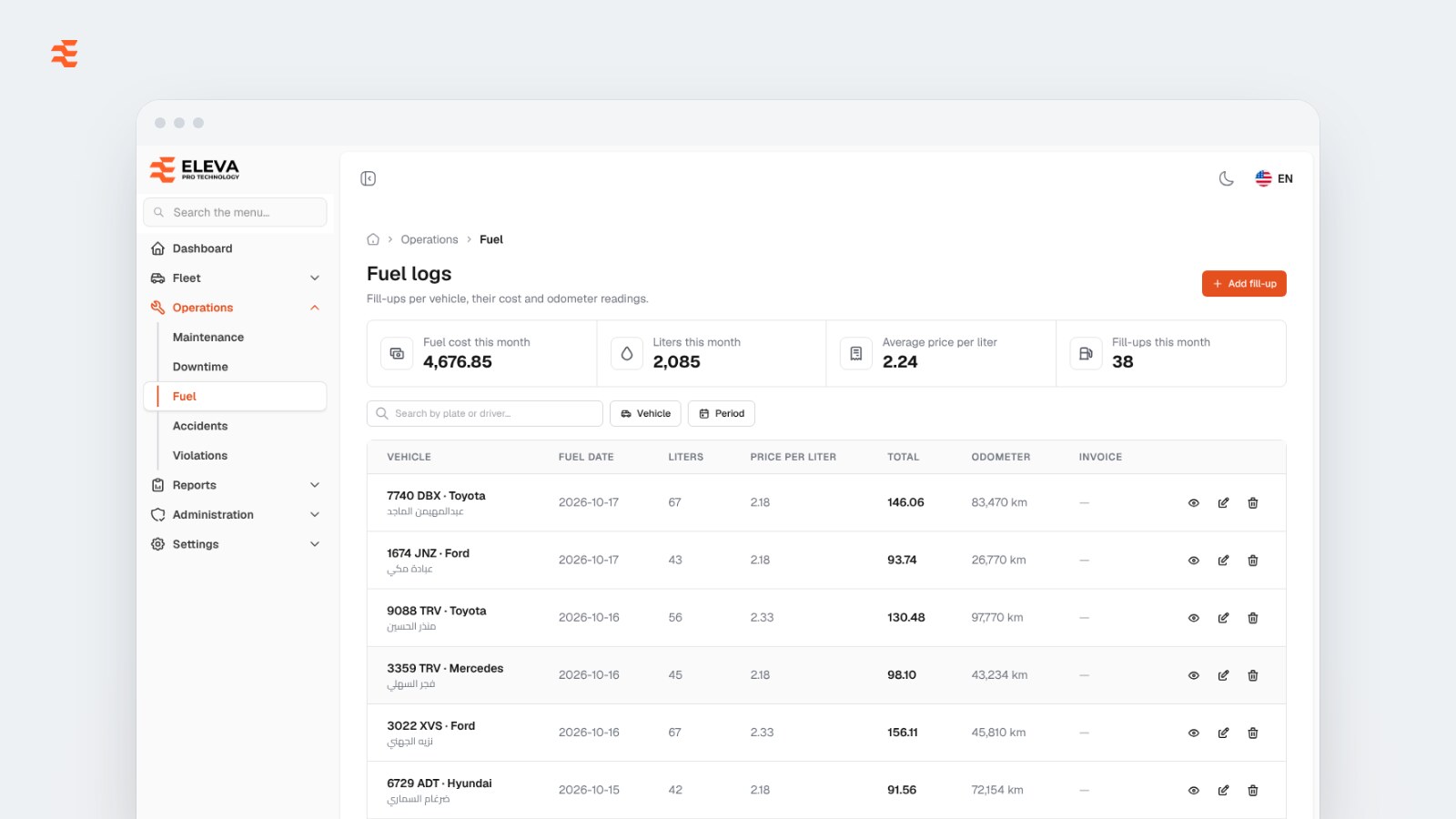
To know what each vehicle really costs, record every cost against the vehicle, the driver and the date it happened: rent or ownership, fuel with the odometer reading, maintenance with its type and next due date, fines with the driver at the time, and the days the vehicle was out of service. Then decide, for every cost, who bears it: the rental company, your company or the driver. Most fleets know their monthly fuel and maintenance totals. Far fewer can say which vehicle burns the most fuel per kilometre, which one keeps going back to the workshop, or how much in fines was actually recovered from drivers. This article sets out what to record, how to read it, and where the numbers usually leak.
Key takeaways
- A cost without a vehicle, a date and a bearer is a number you can't act on.
- Record the odometer at every fill-up; it turns fuel receipts into distance and km per liter.
- Give periodic maintenance a next due date, and close it by recording the next service of the same type.
- Decide who bears maintenance and fines on owned vehicles as a policy, not case by case.
- Read costs per vehicle and per project, not only as company totals.
Which costs make up a vehicle's real cost?
A vehicle's cost is more than its rent or purchase price. For fleet decisions, track at least these six lines per vehicle:
- Rent or ownership: the lease rent, pro-rated by the days it was in service, or the ownership contract price.
- Fuel: liters, price per liter and total for every fill-up.
- Maintenance: each job with its type, cost and who paid.
- Traffic violations: the amount, the driver at the time and who bears it.
- Accidents: the event, the driver and the damage, even when the repair is billed elsewhere.
- Downtime: days out of service; on a lease they cut the invoice, on any vehicle they cost the operation.
Downtime and accidents rarely show up as a single line in the accounts, yet they explain many of the other numbers. A vehicle with high maintenance and frequent downtime is usually telling you something about its age, its route or its driver.
Who bears each cost?
The answer depends on ownership. On a leased vehicle the lessor often covers some maintenance, so each record needs an explicit bearer. On an owned vehicle there is no lessor, so the choice is between your company and the driver, and it should follow a written policy.
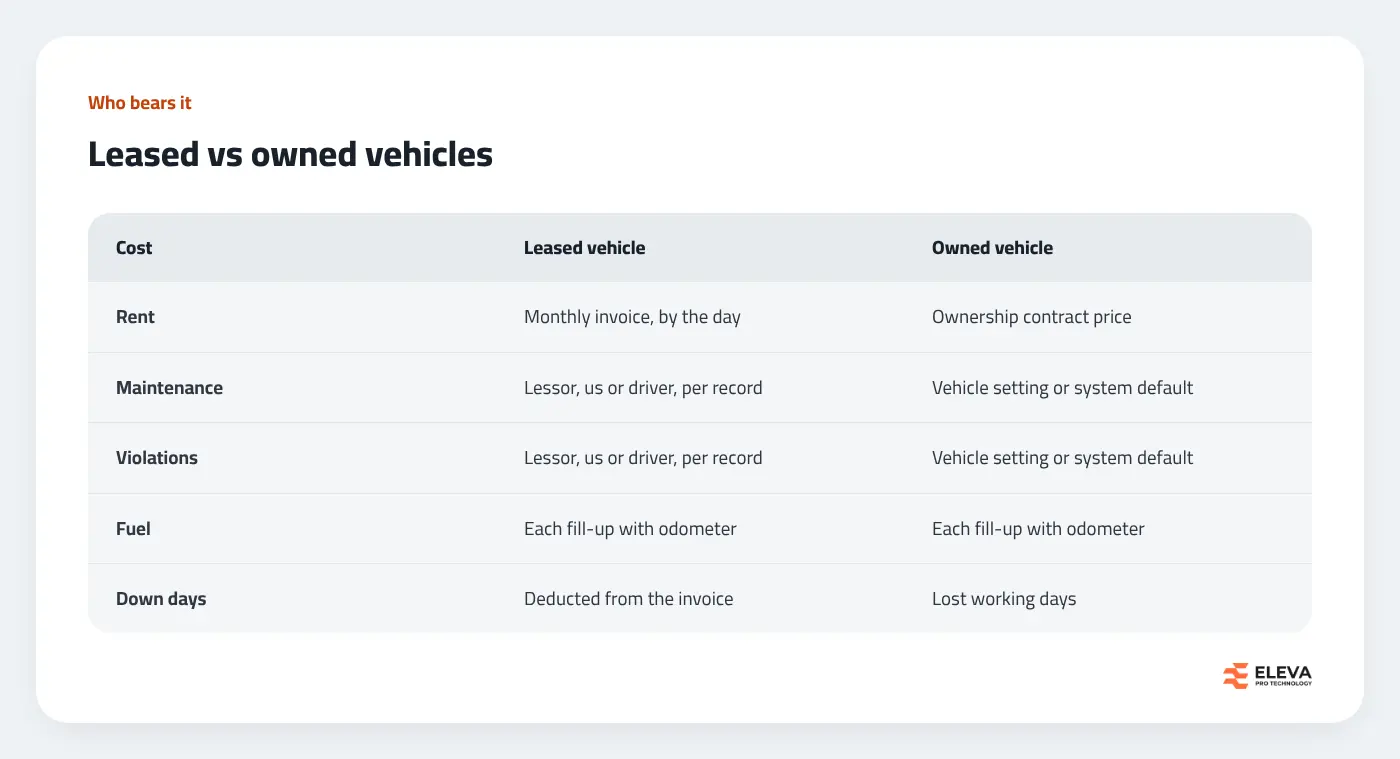
Two rules prevent most confusion. First, set a company-wide default for owned vehicles, with the option to override it for a specific vehicle. Second, never let the bearer be blank. "Charged to drivers" only means something if each fine was actually marked that way when it was recorded.
How do you track fuel consumption properly?
Record the odometer reading at every fill-up, along with the liters and the price per liter. Without the odometer, fuel records only tell you how much was spent. With it, you can see the distance between two fill-ups and the vehicle's km per liter, and compare vehicles of the same type.
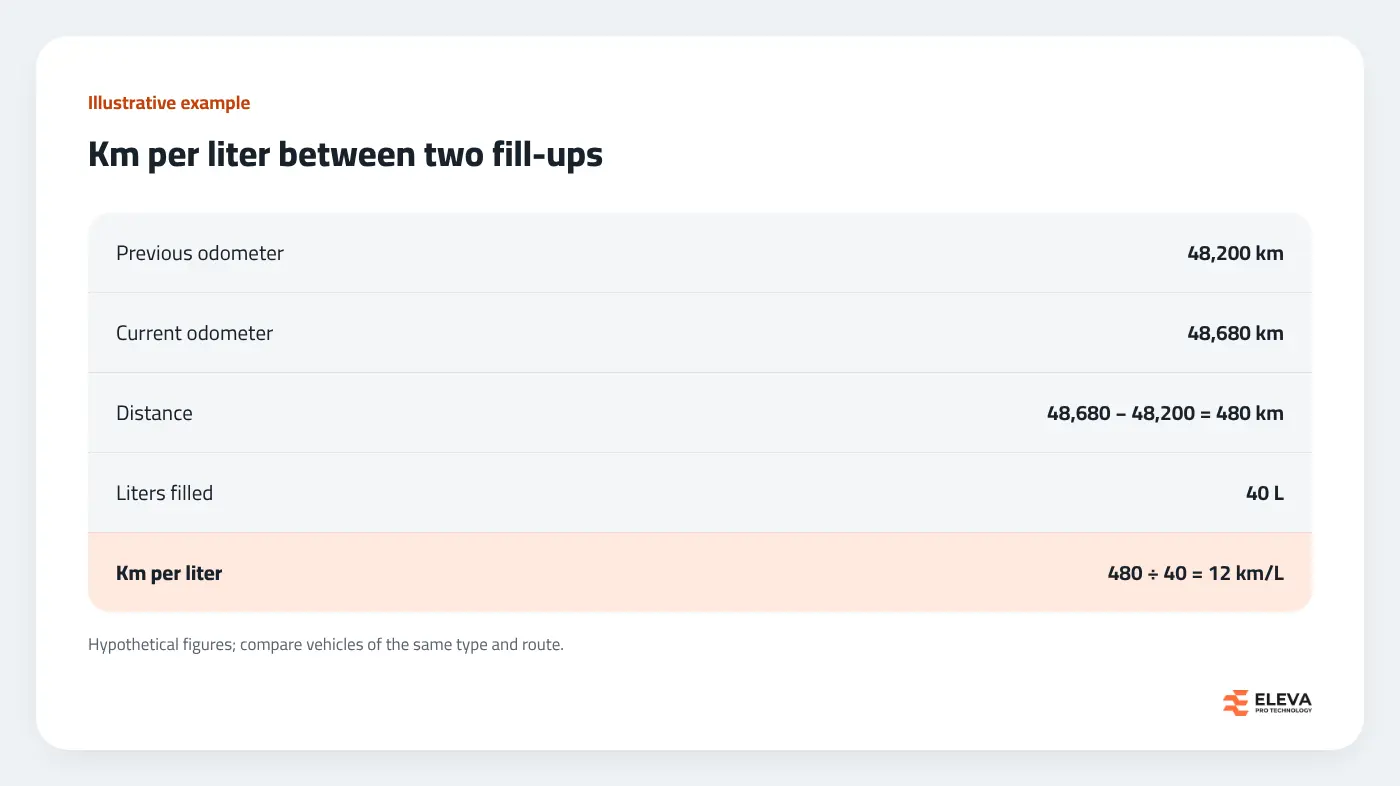
Three habits keep fuel data trustworthy:
- Odometer readings only move forward. A reading lower than the previous fill-up is a typing error or a sign the receipt belongs to another vehicle.
- Keep the receipt with the record. A photo or PDF of the receipt answers questions months later.
- Use the weighted average price. The month's cost divided by its liters gives a fair average price per liter; a simple average of prices overweights small fill-ups.
How do you keep maintenance on schedule?
Give every periodic job, such as an oil change or a brake check, a next due date when you record it. That single field turns a list of past jobs into a schedule. Review it as four groups:
| Status | Meaning | Action |
|---|---|---|
| Overdue | The next due date has passed | Book the vehicle now |
| Due soon | Due today or within 30 days | Plan around the driver's schedule |
| Scheduled | More than 30 days away | No action yet |
| Done since | A later job of the same type was recorded | The old date no longer counts |
To clear an overdue service, record the new maintenance of the same type for the vehicle. Don't delete or edit the old record: its history is what shows how often a vehicle needs work.
How should traffic violations be charged?
A fine is issued against a vehicle, but the cost decision is about a person. Record each violation with its number, date and time, the vehicle, the driver at that moment, the amount and the bearer. If the fine arrives weeks later, the handover record is what tells you who held the vehicle that day; we cover that in vehicle handovers and driver accountability.
Whether a fine can be deducted from an employee's pay is governed by your employment contract, internal policy and the labour law that applies to you; check with HR and legal counsel before adopting a rule. The record's job is to supply the facts: what happened, when, and who was driving.
Where do fleet costs usually leak?
When totals look wrong, the cause is rarely fraud. It is usually one of a few recording gaps that repeat across fleets:
- Fuel with no driver. Fill-ups recorded against the vehicle only, so unusual consumption can't be traced to a person or a shift.
- Repairs paid twice. A job the lessor should have covered is paid by your company because the bearer was never set.
- Fines never recovered. A violation meant for the driver is filed as a company cost because it arrived after the driver changed vehicles.
- Accidents with no downtime. The accident is recorded but the days off the road are not, so the lease invoice is paid in full.
- Costs on the wrong project. A vehicle moved to another project, but its records still sit under the old one.
Each of these is fixed by the same discipline: one record per event, tied to the vehicle, the driver, the date and the bearer.
Which reports answer cost questions?
Different questions need different cuts of the same records:
- "What does this vehicle cost us?" The vehicle's own page, with maintenance, fuel and violation totals.
- "Where does maintenance money go?" A maintenance report by vehicle, type, driver and period, with a total row and the bearer of each cost.
- "What do we owe each rental company?" The monthly invoice summary, with the month's maintenance and violations per company alongside.
- "Is fuel spending rising?" Fuel cost per month over the last year, and the month's liters and average price.
Export these to Excel when finance needs them, and make sure the export includes every filtered row, not only the page on screen.
How does Eleva's fleet system track costs per vehicle?
In the Fleet Management System from Eleva, each fill-up records the vehicle, the driver, the date, the odometer, the liters and the price per liter; the total is calculated, and the details show the previous fill-up, the distance since it and the km per liter. The odometer can't be lower than the previous fill-up's or higher than the next one's, and the receipt is stored privately with the record. The fuel list shows the month's cost, liters, average price per liter and number of fill-ups.
When you add maintenance, you choose the type, enter the cost and the next maintenance date, and attach the file. For a leased vehicle you choose the bearer: Rental company, Our company or Driver. For an owned vehicle the form states the bearer from the vehicle's own setting or the default in System settings. Violations follow the same rule, and the violations list adds up the amount Charged to drivers this year.
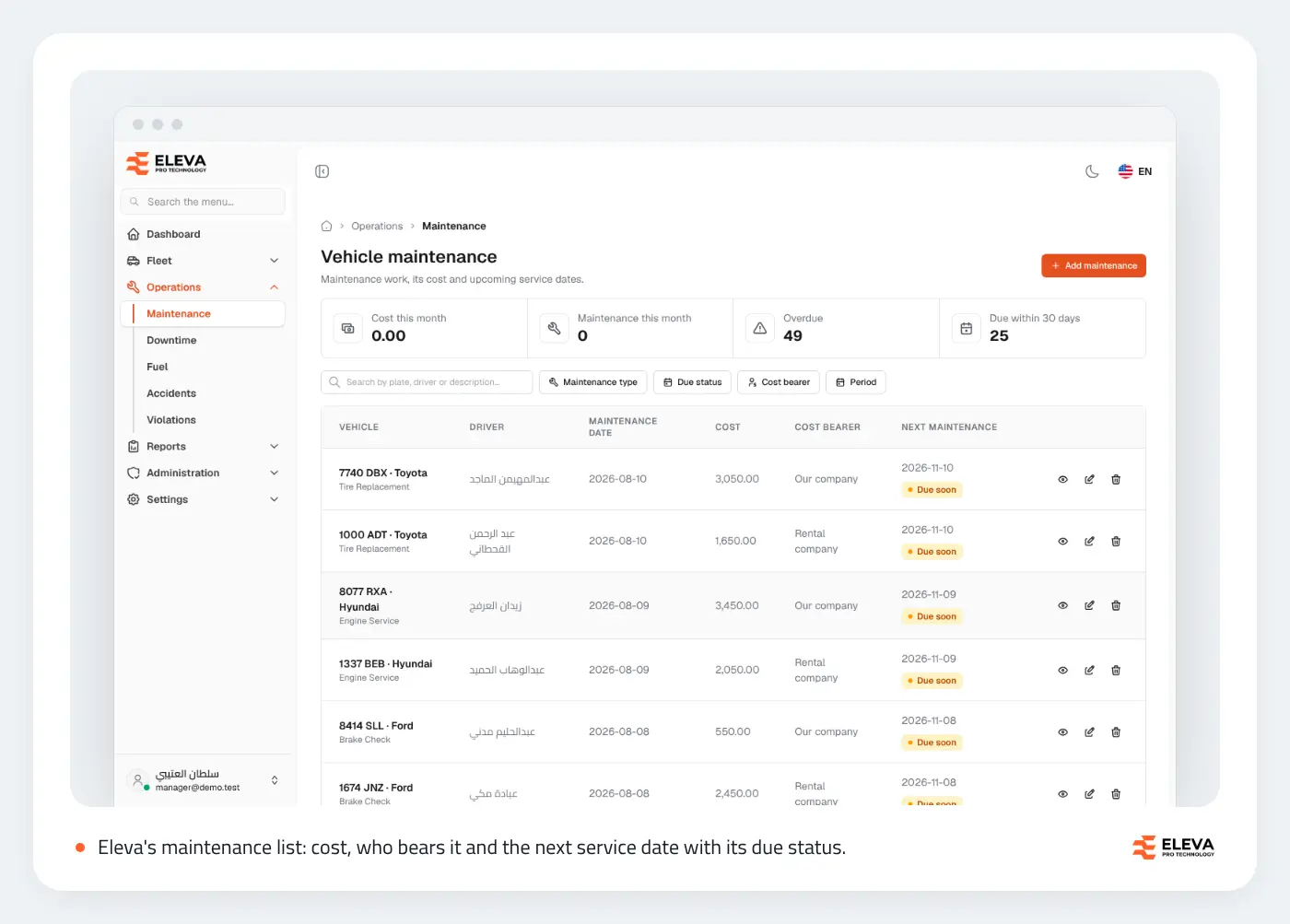
The Maintenance report totals cost by vehicle, driver, type and period with a column for who bore it, and the vehicle page shows maintenance, fuel and violation totals for that vehicle. The dashboard charts fuel cost per month and maintenance cost by type over the last 12 months.
Conclusion
Tracking fleet costs per vehicle comes down to four fields that are easy to skip: the odometer at every fill-up, the next due date on every periodic job, the driver on every fine, and the bearer on every cost. Fill them every time, and the totals start answering questions. For the full checklist of what a fleet system should do, read our guide to choosing a fleet management system, see the Fleet Management System, or contact us.
Try the Fleet Management System yourself: the live demo with sample data, and the step-by-step user manual. The system is sold as a one-time licence or a fixed annual fee plus annual maintenance, installed on your company's server with no fee per vehicle. Request a demo from the product page.