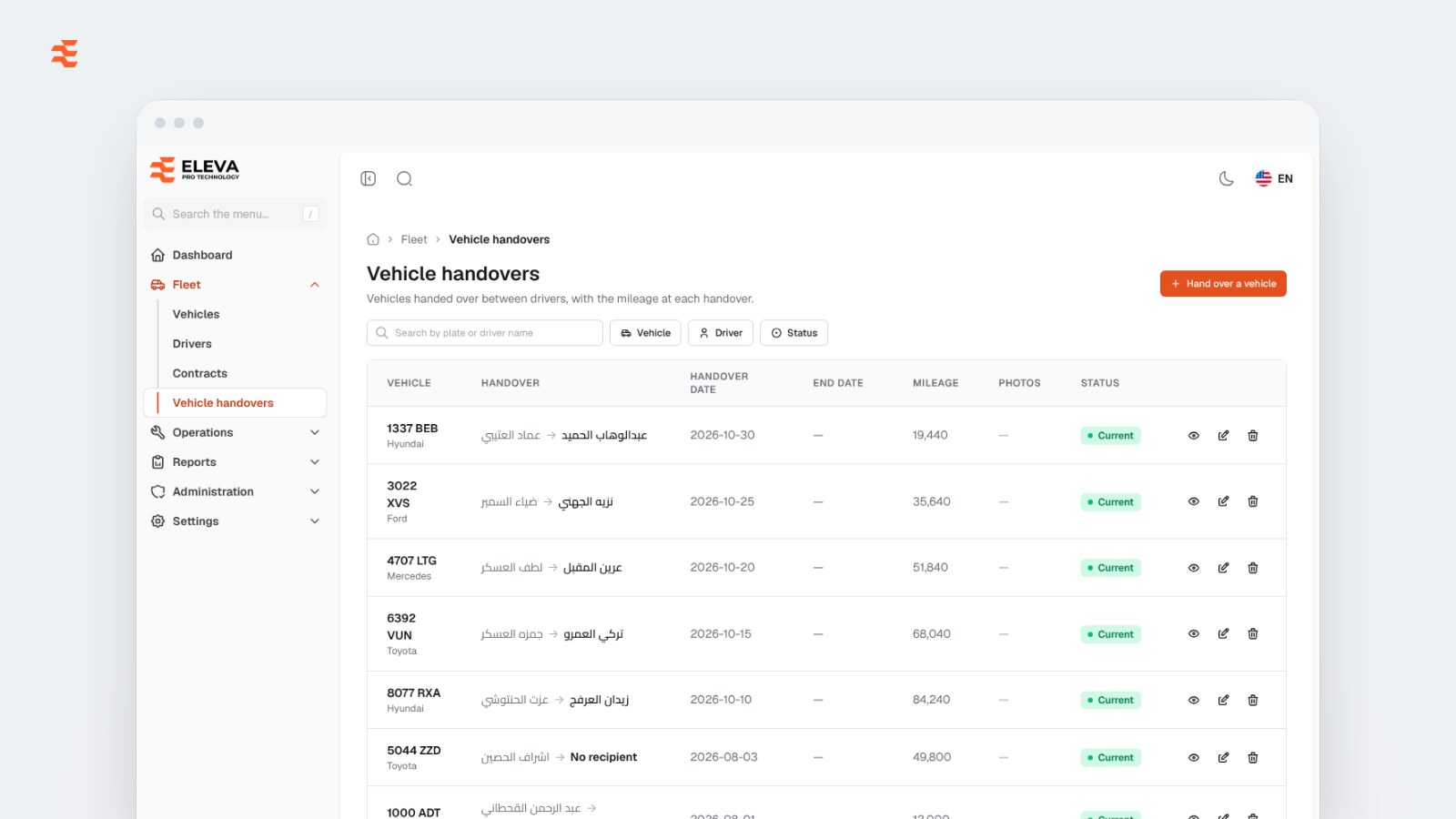
To know who was driving a vehicle on any given day, record every handover as its own event: the vehicle, the driver handing it over, the driver receiving it, the date, the odometer reading and photos of its condition. Let only the current holder hand a vehicle on, never to an inactive driver, one vehicle per driver at a time, and never with a date or mileage that goes backwards. When a fine or an accident claim lands weeks later, that record is what turns "we think it was Khalid" into a fact. This article covers what a handover record should contain, the rules that keep it trustworthy, and how to tie accidents and violations to the right driver.
Key takeaways
- A handover closes the previous one: the history becomes a continuous chain of who held each vehicle.
- Only the driver currently holding a vehicle can hand it over; anything else breaks the chain.
- Odometer and photos at handover settle most disputes about mileage and damage.
- Record accidents and fines against the driver at the time, and record the downtime that follows an accident.
- Deactivate drivers who leave instead of deleting them, so their history stays.
Why does a handover record matter?
In most fleets, vehicles change hands more often than anyone records: a shift change, a driver on leave, a vehicle swapped between projects. Each undocumented swap creates a gap, and gaps cost money later:
- Fines arrive late. A violation notice can come weeks after the event, by which time the vehicle has had two other drivers.
- Damage has no owner. A dent found at the workshop could have happened under any of the last three drivers.
- Mileage disputes. Without a reading at each handover, there is no way to tell whose kilometres those were.
- Drivers leave. When a driver resigns, nobody is sure which vehicle they still hold.
What should a handover record contain?
Keep the record short enough that it is filled every time, and complete enough to stand up in a dispute:
| Field | Why it matters |
|---|---|
| Vehicle (plate) | Ties the event to one specific vehicle |
| From driver | The person releasing responsibility |
| To driver | The person taking it on; empty only for a first assignment |
| Handover date | Opens one driver's period and closes the previous one |
| Odometer reading | Splits the distance between drivers |
| Condition photos | Shows damage that existed before the handover |
| Notes | Fuel level, missing items, warning lights |
A handover lasts until the next handover of the same vehicle. Recording a new one should close the previous one automatically on the new date, so there are never two "current" drivers for one vehicle.
Which rules keep the handover record trustworthy?
A record anyone can edit freely is just a diary. These five rules make it evidence:
- Only the current holder hands over. The "from" driver must be the one who received the vehicle in the previous handover.
- The recipient must be active. A suspended or departed driver can't receive a vehicle.
- One vehicle per driver at a time. A driver can receive a vehicle on the same day they hand their other one on, but not hold two.
- Dates don't go back. A handover can't be dated before the vehicle's previous one.
- Mileage doesn't go back. The reading can't be lower than the vehicle's last recorded mileage.
When a rule is broken, the system should refuse and say why, on the field concerned, rather than save a record that contradicts the rest.
How do you handle first assignments and corrections?
Two situations break handover records more than any other: the first time a vehicle is assigned, and fixing a mistake after the fact.
First assignment. A vehicle that just joined the fleet has no previous holder. Record its first handover with the driver who takes it and no recipient, and with the odometer reading on that day. That reading becomes the floor for every later handover and fill-up.
Corrections. A wrong date or reading should be corrected, not left in place, but the correction must still respect the chain. An edited handover can't move past the next handover's date, and its mileage can't exceed the next handover's reading. If the latest handover was recorded by mistake, delete it and the previous one becomes current again; its photos go with it, so check before you delete.
Shift changes. If two drivers share a vehicle on shifts, decide whether each shift change is a handover. If fines and damage are charged to individuals, it should be.
What should the person handing over check?
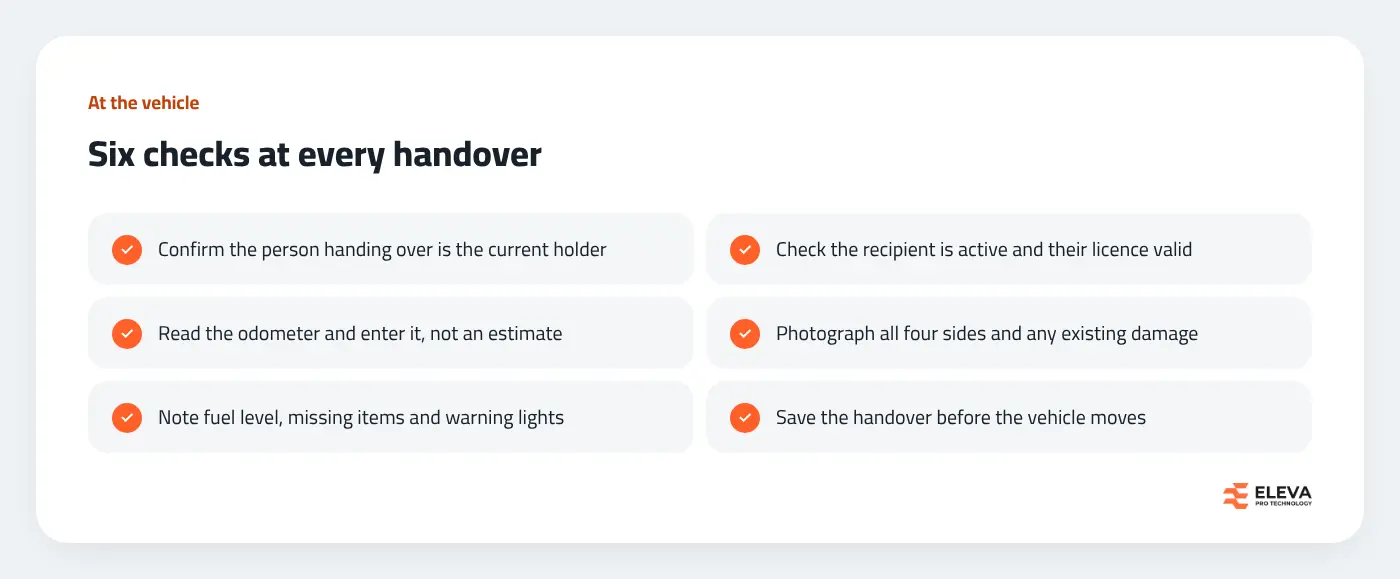
A system can enforce the rules; the checks at the vehicle are still human. Keep them short enough to do every time:
How do you tie accidents and violations to the right driver?
With a reliable handover chain, the driver for any date is a lookup, not an investigation. Then make sure each incident is recorded the same way:
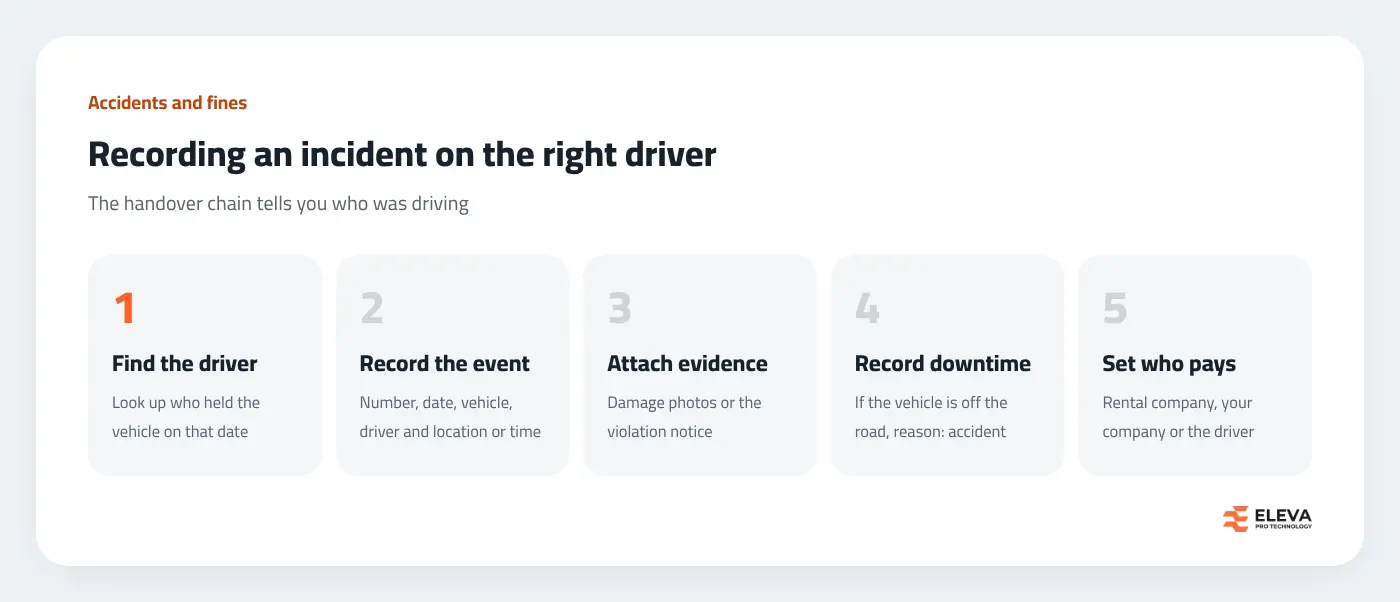
For accidents, record the accident number (for example the police or insurance report number), the date, the vehicle, the driver and the location, with photos of the damage. If the vehicle is out of service afterwards, record a downtime with the reason "accident" as well; on a leased vehicle that is what removes those days from the rent.
For violations, record the notice number, the date and time, the vehicle, the driver at that moment, the amount and who bears it. Whether a fine can be recovered from the driver depends on your employment contracts, internal policy and applicable labour law, so agree the policy with HR before applying it. The record should simply make the facts clear.
How should driver records support this?
Handovers rely on a clean driver list. Each driver needs a licence number, licence type and expiry, an ID number, a mobile number and a supervisor responsible for them. Review drivers whose licence has expired or expires within 30 days, and don't hand vehicles to them until it is renewed.
When a driver leaves, deactivate them rather than delete them. A deactivated driver can't receive a vehicle, and their handovers, accidents, violations and fuel records stay intact for the next audit or dispute.
How does Eleva's fleet system handle handovers?
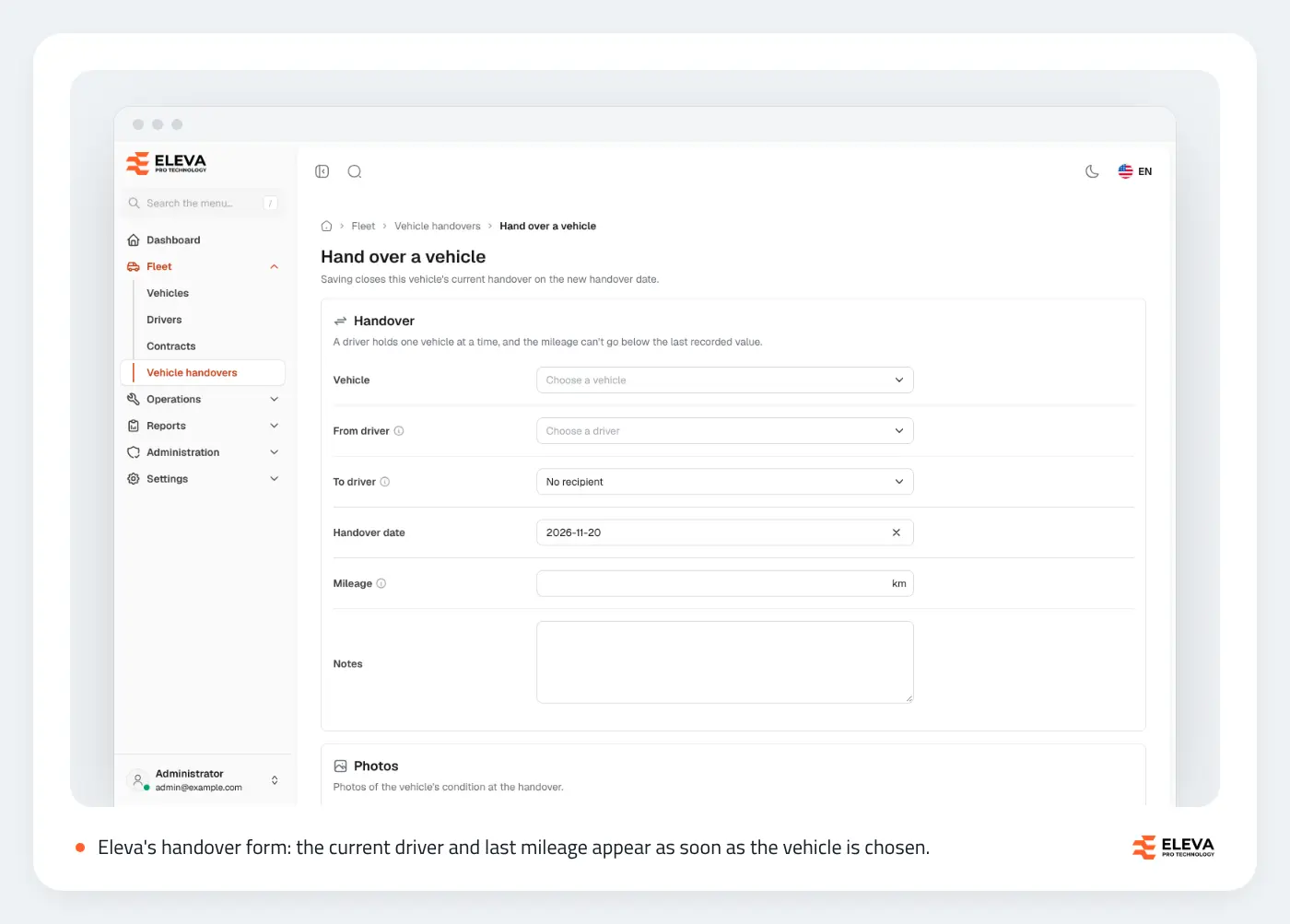
In the Fleet Management System from Eleva, the Hand over a vehicle form shows the vehicle's current driver and last mileage as soon as you choose it, and suggests that driver in From driver. You choose To driver (or No recipient for a first assignment), enter the date and mileage, and add up to 10 photos at a time. Saving closes the previous handover on the new date. The five rules above are enforced on saving and when editing, and the photos are private: only users with permission on handovers can open them.
The Vehicle handovers list filters by vehicle, driver and status, and Current shows who holds each vehicle now. Each driver page shows the current vehicle and the handover history with period and mileage, plus accidents, violations, fuel and maintenance. Accidents take up to 20 private photos each, and violations record the driver at the time and the amount bearer, with fines borne by drivers adding up in Charged to drivers this year. A driver with any history can't be deleted; they are deactivated instead.
Conclusion
A trustworthy handover record is a chain with no gaps: every vehicle has exactly one current driver, every handover has a date, a reading and photos, and every fine or accident points to the driver at the time. Set the rules once and let the system refuse anything that breaks them. For the wider view of what a fleet system should do, read our guide to choosing a fleet management system, see the Fleet Management System, or contact us.
Try the Fleet Management System yourself: the live demo with sample data, and the step-by-step user manual. The system is sold as a one-time licence or a fixed annual fee plus annual maintenance, installed on your company's server with no fee per vehicle. Request a demo from the product page.